
A business or corporate legal notice shares important information with the public through an approved publication or official channel. Companies use notices to announce filings, name changes, creditor deadlines, public hearings, and other actions. Requirements depend on the jurisdiction, notice type, and organization. Therefore, owners should confirm local rules before they publish.
A properly placed notice can alert creditors, customers, bidders, or community members who may have a legal interest. In some places, statutes or regulations require publication before a company completes a particular action. For example, a state may require a new limited liability company to publish formation information. A city may also require a public notice before an agency awards a contract. Publication creates a dated public record, but it does not replace filings with government offices.
Who reviews Business or Corporate Notices
Business owners, corporate officers, attorneys, accountants, and government procurement staff may all help coordinate a notice. However, the person responsible should identify the rule and deadline first. Check the relevant state statute, agency instructions, court order, or local ordinance. Then ask the designated office whether it accepts print publication, online publication, or both. Avoid relying on a general checklist when a specific rule controls.
Business or Corporate Legal Notice Requirements
**Common filing notices.** Many jurisdictions require some newly formed companies or assumed business names to publish a notice. The rules may apply to new registrations, LLC formations, and business name changes. A notice might identify the company, its principal address, the filing date, and the office that received the filing. Still, states differ. Some require publication in a named newspaper, while others do not require publication at all. Confirm the current rule with the filing agency before placing an order.
Contract and public meeting notices.
Government agencies often publish contract opportunities so qualified vendors can compete. They may also announce public hearings, requests for proposals, or planned actions that affect residents. In addition, an agency may need to publish notice before it awards a contract. Procurement staff should follow the governing policy, specify submission instructions, and allow the required response period. A clear notice helps vendors find key dates and reduces confusion about eligibility.
Other business announcements.
Companies may publish notices about creditor claims, dissolutions, mergers, lost share certificates, or court proceedings. The exact language and timing can carry legal consequences. Therefore, use the wording required by the applicable rule or approved by counsel. Do not treat a marketing announcement as a substitute for a formal legal notice. The two serve different purposes and may reach different audiences.
Preparing a Business or Corporate Legal Notice
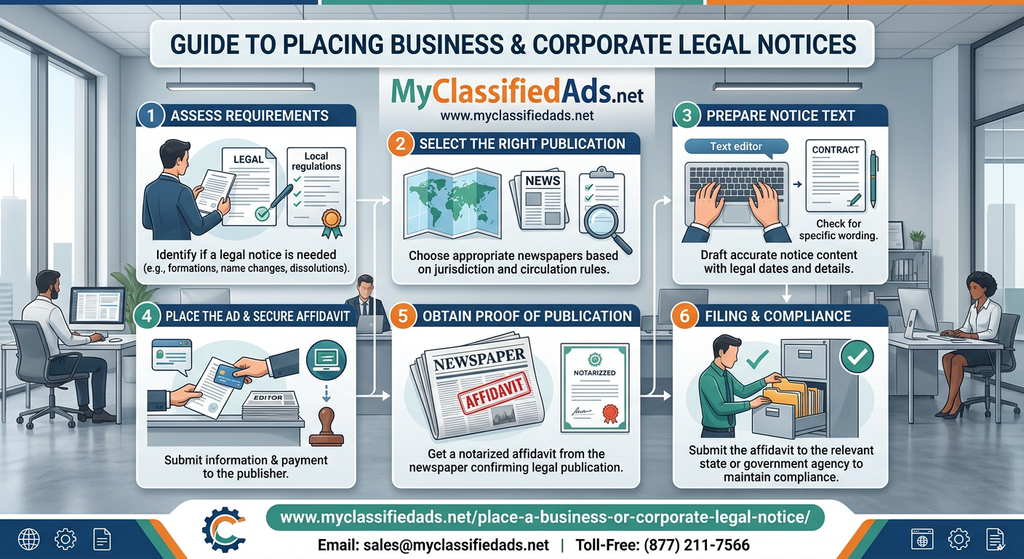
Before drafting, collect the company’s exact legal name, entity type, address, registration or case number, and relevant dates. Identify the action the notice announces and the audience it must reach. For a public bid, include the project description, eligibility terms, contact details, and deadline. For a creditor notice, state how and where claimants should submit a claim. Check every name and number against the official record.
Readers should understand who is acting, what will happen, and when they must respond. Include the required contact person, address, web link, or document reference. Also, define uncommon abbreviations and avoid promotional claims. A short notice can still provide all required facts. However, cutting a mandatory detail may force a correction or a new publication, which can delay the underlying process.
Review before submission.
Ask a second person to compare the draft with the governing instructions. Confirm dates, spelling, addresses, publication length, and any required legal wording. Next, verify whether the notice needs one insertion or several. Some rules count calendar days; others count publication dates or business days. When instructions conflict or remain unclear, contact the issuing agency or a qualified lawyer rather than guessing.
Placing a Business or Corporate Legal Notice
**Choose an eligible publisher.** The governing rule may name an official newspaper, prescribe circulation requirements, or designate a government website. Contact the publisher early and ask about deadlines, formatting, pricing, and the documents it needs. For instance, a newspaper may request a signed order and proof of the underlying filing. Confirm that the proposed publication meets the rule before paying. A widely read outlet may not qualify if the law specifies another channel.
**Track dates and delivery.** Build a schedule backward from the filing, hearing, response, or bid deadline. Allow time for review, publication, corrections, and proof delivery. If the notice must run more than once, record each insertion date. Meanwhile, keep a copy of the approved text and the publisher’s order confirmation. These steps help the team spot a missed deadline while there is still time to respond.
**Request proof of publication.** After publication, obtain an affidavit, certificate, tear sheet, or other evidence required by the agency. Check that it shows the correct text, outlet, and publication dates. Then store the proof with the company’s filing or contract records. A payment receipt alone may not prove that the notice appeared as required. If the publisher made an error, notify it promptly and ask the agency or counsel how to correct the record.
Business or Corporate Legal Notice Compliance Checklist
Keep a reliable record. Save the final notice, the source rule, correspondence, invoices, and proof of publication together. Record who approved the text and who confirmed the deadline. In addition, note any agency guidance about acceptable formats or delivery methods. A consistent file helps future staff answer questions and supports an audit or dispute. Retain records for the period required by company policy or applicable law.
**Avoid common mistakes.** Businesses can miss deadlines by assuming every state follows the same publication rule. They can also use an outdated company name, omit a response address, or choose an ineligible publisher. Another frequent problem involves treating proof of publication as an optional receipt. Instead, confirm each requirement before publication and verify the evidence afterward. These simple checks reduce preventable delays.
**Know when to seek legal advice.** A routine notice may need only careful coordination, but unusual facts deserve professional review. Consult counsel when a notice affects creditor rights, a contested proceeding, a merger, a dissolution, or a government award. Likewise, get help if the deadline has passed or the published text contains an error. A lawyer can assess whether correction, republication, or another filing may address the issue.
**Final takeaway.** A business or corporate legal notice works best when the responsible team follows the exact rule, uses accurate language, and preserves proof. First, identify the authority and deadline. Then prepare and review the notice, place it through an eligible channel, and confirm publication. Because requirements vary by location and purpose, verify the details with the relevant agency or qualified counsel. Careful planning makes the process clearer for the company and the public.
new business registrations, LLC formations, and business name changes published in print.
Business Filings and Government Contracts Many states require newly formed LLCs or fictitious business names to publish a notice. The goal is to prevent fraud and stop duplicate business names. Above all, agencies must publish government contract bids before they can award contracts.