
The PERM labor certification is the first step for most employers who wish to sponsor a foreign worker for a green card. The U.S. Department of Labor (DOL) oversees this process. Employers must prove two things: they will pay at least the prevailing wage, and hiring a foreign worker will not harm American workers. This process includes strict rules, careful timing, and a clear strategy. It usually takes six to eight months to complete.
Gather Complete Job Details for the DOL
The PERM application requires exact details about the job. Employers must include the job title, required skills and experience, work location, and salary. These details must match throughout the entire process. Changing key details, such as the job title or wage, after starting the process, can lead to a denial. To avoid mistakes, employers should plan all job details before submitting any paperwork.
Pay the Prevailing Wage for PERM Labor Certification
Employers must offer at least the prevailing wage for the job. The DOL sets this wage based on the job and its location. Employers request a prevailing wage determination from the DOL before starting recruitment. Paying below this wage will cause the application to fail. Employers should prepare financial documents in advance to prove they can pay the required salary.
Document the Ability to Pay Throughout the Process
Proving the ability to pay is essential. Large companies find this easy by using payroll records or tax returns. Small businesses should keep financial statements ready. Employers must show they can pay the listed salary from the date the PERM is filed until the worker gets a green card. If employers cannot show this ability, the DOL may reject the application. Providing pay stubs or W-2s makes the process smoother.
Complete the PERM Recruitment Steps with the DOL
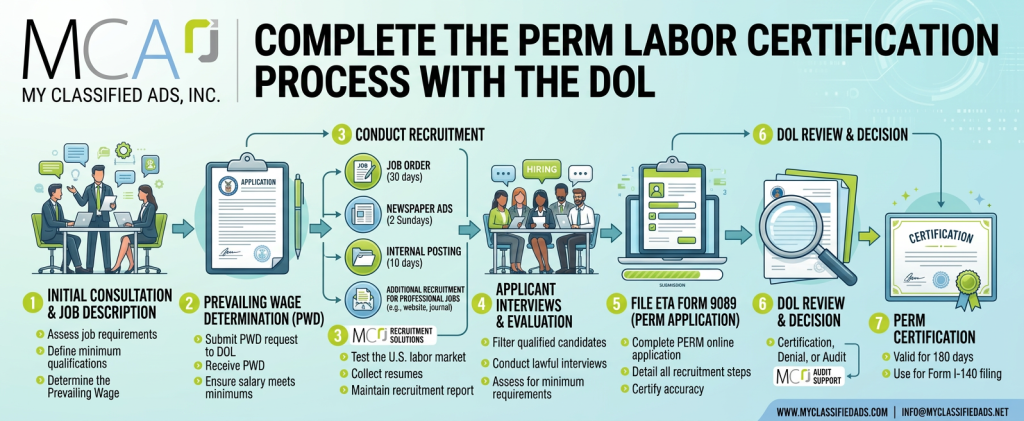
Recruitment is a critical part of the PERM process. Employers must advertise the job in several places, such as newspapers and online, and post it at the job site. Each ad must match the job details on the PERM application. Employers must keep proof of all ads and resumes received. Skipping any recruitment step will result in denial.
Handle Layoffs Carefully During PERM Labor Certification
Layoffs matter. If the company has laid off workers in the same field within six months before filing, the employer must notify and consider those former employees for the new job. Failing to do so could stop the process. Employers should review layoff records before starting PERM. This step can save time and prevent issues.
Stay Consistent Across All PERM Documents
Consistency is key in every step. Employers must keep the same job title, duties, location, and wage in all documents. Even small changes, like a new job site or a higher wage, can force employers to restart the process. Employers should double-check all paperwork before each step.
Prepare for Possible Delays in the PERM Process
The PERM process can take months or even years, especially for workers from certain countries with long green card wait times. Employers should plan for these delays and keep the job open until the worker receives permanent residence. Keeping good records helps if the DOL requests more information later.
Stop the PERM Application if Qualified U.S. Workers Apply
One main goal of the PERM process is to protect U.S. jobs. If a qualified and willing American applies for the job, the employer must stop the process. Employers cannot continue unless no qualified U.S. worker wants the position. If this happens, the company can try again after six months.
Finalize and File the PERM Labor Certification with the DOL
Once all steps are complete, employers submit ETA Form 9089 to the DOL. The DOL reviews the application and may request more documents. Employers should respond quickly to any requests. If the DOL certifies the PERM, the employer can continue with the next steps of the green card process.
Completing the PERM labor certification process with the DOL requires careful planning, strong documentation, and close attention to detail. Employers should follow each step, keep records, and avoid changing job details. By staying organized and proactive, employers can complete the process efficiently and support their sponsored worker’s path to permanent residence.(PERM) labor certification process with the U.S. Department of Labor (DOL).
Most U.S. employers seeking to sponsor a foreign national for a green card must first complete the Program Electronic Review Management (PERM) labor certification with the Department of Labor (DOL).
This process is designed to ensure that (1) the employer offers at least the prevailing wage for the job in the region, and (2) hiring a foreign worker will not negatively impact U.S. workers by taking away their job opportunities. Though these objectives seem straightforward, the PERM process is actually complex, costly, and time-intensive, requiring careful navigation of strict rules, precise timing, and strategic planning over six to eight months. Once granted, the certification must remain valid for a significant period afterward.
It is important to note that employers are responsible for all costs associated with the PERM process.
Including attorney fees and recruitment expenses—employees cannot contribute financially. Because the labor certification process is both time-consuming and expensive, employers should thoroughly understand PERM requirements before starting. This guide outlines five critical factors every employer should know, as a successful green card application hinges on mastering these core elements of PERM compliance.
Make sure the PERM labor certification remains valid when the sponsored employee eventually receives permanent residency, which could be several years after the process begins.
When starting the PERM labor certification, employers should keep in mind that the foreign national must be able to perform the specific job described in the certification at the time the green card is approved. The timeline for certification also differs considerably based on the employee’s country of origin and the nature of the job.
On the PERM application (ETA Form 9089), employers must specify crucial details such as the job title, duties, qualifications, location, and salary. These details should anticipate any changes that could occur before the green card is issued. Because the U.S. Department of State’s Visa Bulletin changes monthly, backlogs can vary widely. For example, an employee from India in a highly skilled role may wait seven to nine years for a green card. While a similarly qualified employee from Ghana could proceed much sooner after PERM approval.
Given potential delays, a PERM labor certification stays valid only for the geographic location listed on the application.
So moving the employee to a different area means starting the process again. Minor changes like a new job title or salary increases after filing generally do not affect the PERM’s validity.
The main consideration for whether a new PERM is necessary comes down to the job duties. If the employee continues performing most of the original responsibilities, the certification typically remains valid. However, if essential duties are removed or major managerial functions are added, a new application is needed. Minor changes to job tasks usually don’t require a restart. But significant changes—like ongoing promotions—may mean a new PERM is unavoidable.
Why this may not be so bad
To avoid having to file a new PERM due to future changes, it’s wise to describe the job on ETA Form 9089 in a way that allows the employee to advance within the company yet still perform the core functions of the certified position when the green card is issued. Understanding this can help employers conserve resources and better set expectations for their international hires.
Demonstrate your ongoing ability to pay the full offered salary from the time you file PERM until the employee receives permanent residence.
Large businesses with more than 100 employees usually find it straightforward to prove they can pay the required wage. Smaller companies, especially those operating at a loss, must gather strong evidence of their ability to meet wage commitments before beginning the PERM process. The wage offered to the employee—listed in Section G of ETA Form 9089—must be at least the Department of Labor’s prevailing wage for that role. This obligation to show financial capability starts when the PERM is filed and continues until the green card is approved. The closest review of an employer’s finances typically happens during the I-140 petition step with U.S. Citizenship and Immigration Services (USCIS), which follows PERM certification.
The simplest way for an employer to prove its ability to pay is by actually paying the employee the offered salary from the date the PERM is submitted, documented by W-2s or pay stubs. If this isn’t possible, other documentation—such as annual reports, SEC filings, tax returns, audited statements, or a CFO letter—is required for larger employers to show sufficient profitability to cover the wage.
Monitor recent or planned layoffs, as these may prevent you from moving forward with a PERM application.
If a company has had layoffs in the past four to six months or expects to lay off workers in the next six months, this can create significant challenges for obtaining PERM certification.
A layoff only impacts the PERM process if it happens in the same location and involves roles related to the job being sponsored. The affected employees must be U.S. citizens, green card holders, or asylee/refugee workers. If any such layoffs occurred within six months before filing, the employer must prove it notified and considered all qualified workers for the new position. This process can be complicated, so reviewing layoff records before starting a PERM application is crucial.
Alterations to the job—like promotions, pay increases, or location changes—can invalidate a pending PERM, forcing the employer to restart the entire process.
Consistency is key throughout the PERM process: job duties, location, wage, and all other position details must align from the initial prevailing wage request through recruitment and the PERM filing. Changes made either before or after filing—like raises or promotions—can compromise the application’s validity.
For instance, if the PERM advertises a job at a lower salary and then the employee is promoted to a higher-paying role before filing, this discrepancy could raise compliance concerns. The original wage might not attract as many U.S. applicants as the higher, current wage, leading to questions about the fairness of the recruitment process. To minimize risk, employers should avoid modifying significant job details during the PERM process.
If any qualified U.S. candidates apply for the sponsored job, the PERM process must stop.
PERM is designed to confirm that no U.S. worker is available, willing, and qualified for the sponsored position, and that hiring a foreign worker won’t harm the wages or conditions of U.S. employees. Employers must act in good faith, carefully evaluating all applicants from the recruitment process. If even one minimally qualified U.S. worker is willing to take the job, the PERM process must be stopped. However, employers may start over after waiting six months.